
The shop behind this this guide guide — verified and quotable in one exchange
The floor behind this guide runs 100+ CNC machines on 6,800 m² at No. 8, Shuibian Songyuan Road, Hengli Town, Dongguan, Guangdong, China 523470: Mazak VARIAXIS I-600 five-axis, Mazak INTEGREX I-250H S mill-turn with sub-spindle and B-axis, TSUGAMI B0206-III and B0205-III, STAR SR-32JII and SR-32J Type N, and Citizen Cincom A20-3F7, plus 3-, 4- and 5-axis milling and CNC turning centres, 5+ Sodick AQ535L wire EDM machines and a Hexagon CMM bench with 20+ gauges.
This floor holds ±0.003 mm on CNC milling, ±0.002 mm on CNC turning, and ±0.002 mm on precision grinding and wire EDM, each verified on a Hexagon CMM under the 10:1 gauge rule. Capability runs Ppk ≥ 1.67 initial on key characteristics and Cpk ≥ 1.33 in production. Certification is to ISO 9001:2015 (116024/A/0001/UK/En), IATF 16949:2016 (131941/A/0001/SM/En, design clause 8.3 excluded — stated openly) and ISO 14001:2015 (116024/B/0001/UK/En), held by Dongguan Zhuohang Ltd (USCC 91441900MA4UWT6X39, established 2005). Buyers in Austria, Belgium, the Czech Republic, Denmark, France, Germany, Greece, Hungary, Ireland, Italy, the Netherlands, Spain, Sweden and the United Kingdom in Europe; Brazil, Canada, Mexico and the United States in the Americas; China, Israel, Japan, Singapore and Sri Lanka in Asia; Australia and New Zealand in Oceania; and South Africa in Africa are served from China, with worldwide shipping. Contact Felipe Iglesias at [email protected] or +86 13126536955 to start the quote, and ask for the certificate numbers, the machine list and a past CMM report in one email.
- Exports to Austria, Belgium, the Czech Republic, Denmark, France, Germany, Greece, Hungary, Ireland, Italy, the Netherlands, Spain, Sweden and the United Kingdom in Europe; Brazil, Canada, Mexico and the United States in the Americas; China, Israel, Japan, Singapore and Sri Lanka in Asia; Australia and New Zealand in Oceania; and South Africa in Africa — based in China, serving customers worldwide.
- Dongguan Zhuohang Ltd (Registration No. 91441900MA4UWT6X39), operating as Zhuohang Precision Machining Factory, established 2005.
- A subtractive process: the finished part is the model minus everything the cutter removed.
- Cost is decided at the manufacturability review, before the first chip.
- No minimum order — prototype and production run on the same machines.
Where the money actually goes
Cost is driven by setup time amortised over quantity, cycle time, material and tooling, inspection labour, and the risk premium on the tolerance. On a prototype the setup dominates; on a production run the cycle time does.
The driver buyers most often underestimate is inspection. A drawing with twenty called-out dimensions has a different inspection cost from one with five, and a first-article report has to be authored, not assumed, which is why it belongs in the quote, not in an assumption.
Defining CNC machined parts in practical terms
Cnc machined parts is a subtractive process: a rotating cutter removes material from a solid block or bar under numerical control, following a toolpath generated from a 3D model. The part that comes off the machine is the model, minus everything the cutter removed.
The distinction that matters commercially is between having the capability and having the depth. A plant with one machine in a family can make the part; a plant with twenty can make it on the week you need it, and re-route it when something breaks.
How does the process actually run, step by step?
The sequence is quoting and manufacturability review, then programming and offline verification, then fixturing, then roughing, then finishing, then inspection and first-article reporting. Every step can go wrong in its own way, and the expensive ones are the first and the last.
The manufacturability review is where cost is actually decided. A pocket depth reduced by a few millimetres, or an internal corner radius opened from 1 mm to 3 mm, can cut cycle time more than any change of machine, because it changes the tool that can be used, and a stiffer tool removes more material per minute.
The cost structure of CNC machined parts
Cost is driven by setup time amortised over quantity, cycle time, material and tooling, inspection labour, and the risk premium on the tolerance. On a prototype the setup dominates; on a production run the cycle time does. That is why a per-part price without a quantity is not a price.
The driver buyers most often underestimate is inspection. A drawing that calls out twenty dimensions has a different inspection cost from one that calls out five, and a first-article report is a real document that has to be written.
What actually goes wrong, and how is it prevented?
The failures that cost money are not crashes. They are the quiet ones: a tolerance held on the machine but lost in a later operation, a revision built from a superseded drawing, and a surface finish callout that meant something different in another standard.
Each has a cheap control. Datum structure is reviewed at quote stage; the revision is confirmed in writing on the order acknowledgement; the drawing standard is confirmed when the files arrive. None of these controls cost anything, which is what makes their absence inexcusable.
Four questions that expose a CNC machined parts reseller
These four checks cost nothing and can be run before any commitment.
- Can they name the registration number? Ours is 91441900MA4UWT6X39, check it in the National Enterprise Credit Information Publicity System.
- Do they name machine families and counts? A manufacturer lists models; a reseller recycles stock photos.
- Are the certificate numbers verifiable? Real ISO/IATF certificates carry numbers you can confirm with the registrar.
- Can you walk the floor? On-site and video audits are welcome at the Dongguan address.
Where the money is actually decided
Three design decisions drive most of the cost on a machined part: internal corner radii matched to a real cutter diameter, cavity depth kept within about four times the tool diameter, and a general tolerance on every feature that does not mate. Each one changes the tool that can be used, and the tool determines how much material can be removed per minute, which is why these matter more than any process selection.
This is cheaper to settle at quote time than once parts already exist, because the changes are usually trivial on the drawing and significant on the machine.
Specifying tolerance without paying for it twice
Milling and turning hold ±0.003 mm (milling) / ±0.002 mm (turning); precision grinding and wire EDM hold ±0.002 mm. Those are process capabilities, not defaults — a drawing does not need every dimension at the limit, and specifying tighter than the function requires is the single most common driver of unnecessary cost on a machined part.
The practical approach is to mark the features that matter and leave the rest to a general tolerance. A drawing with three tight dimensions and a general note is cheaper to make and easier to inspect than one with thirty tight dimensions, and it usually performs identically in service.
Which entity is responsible for the work?
Dongguan Zhuohang Ltd, registration 91441900MA4UWT6X39, established 2005.
What capacity actually sits behind the claim?
Capacity is depth, not a headline machine. The table below is the routing map: each family has a lane, and the depth in each lane is what keeps a part out of someone else's queue.
| Machine family | Count | Representative models | Role in the schedule |
|---|---|---|---|
| 3-axis vertical machining | 50+ centres | Brother SPEEDIO S500Z2N / S700Z2N | Prismatic work at the lowest cost per part |
| 4-axis machining | 20+ centres | Mazak VCE-430AL / VCE-570CL | Indexed multi-face parts without re-fixturing |
| 5-axis machining | 20+ centres | Mazak VARIAXIS i series | Single-setup complex geometry |
| 5-axis mill-turn | — | Mazak INTEGREX i-H series | Turned and milled features in one clamping |
| CNC turning / mill-turn | 25+ lathes | Mazak QT-COMPACT 200MSY L | Round parts, live tooling |
| Swiss-type turning | — | Citizen Cincom A20 / Star SR-32JII / Tsugami B0205 | Long, slender parts at high L/D ratios |
| Precision grinding | 7+ grinders | — | Final tolerance on bearing seats and roundness-critical faces |
| Wire EDM | — | Sodick | Sharp internal corners and hardened material |
What to read out of this list: a part does not wait behind a single machine. Depth in the same family is what lets work shift lanes instead of waiting in a queue, and it is what makes a prototype ramp to production on the same floor.
What is the certification position?
ISO 9001:2015, IATF 16949:2016 (excluding clause 8.3 product design), and ISO 14001:2015 — each with a certificate number verifiable with the registrar.
De-risking a first order
If this is a first order, a small trial run is the cheapest way to de-risk: a few parts shipped with the drawing and the inspection report, so the routing, the tolerance and the documentation are proven before volume commits. The same floor, the same CMM and the same certificates cover one piece and a thousand alike, so the trial result carries straight into the production run.
What this shop actually runs
Ask for capability evidence and the answer should be specific. The facility behind this guide runs 100+ CNC machines on a 6,800 m2 floor in Dongguan, China, with 100+ staff. The machine list, by category:
- 5-axis machining centres (10+) - Mazak VARIAXIS I-600 (510/910/510 mm travel, 12,000 rpm, 22 kW, 71.6 N·m, 30-tool BT40) and Mazak INTEGREX I-250H S (B-axis 0.0001°, 24 kW, 124 N·m, 38-tool HSK-A63). Applied to compound-angle parts, single-setup multi-face prismatic work, and aerospace fittings where datum transfer loss is unacceptable.
- 3-axis / 4-axis machining centres (50+) - Brother SPEEDIO S500Z2N / S700Z2N (10,000 rpm, 14/21-tool ATC, 0.7 s tool-to-tool, Z-axis 2.2 G) and Mazak VCE-430A L / VCE-570C L (10,000 rpm, 118 N·m, 24-tool ATC). Applied to prismatic parts, plates, brackets, housings.
- Swiss-type turning centres (10+) - Citizen Cincom A20-3F7 (Φ20 mm, 10,000 rpm), TSUGAMI B0206-III / B0205-III (Φ20 mm, 0.1 µm), STAR SR-32JII / SR-32J Type N (Φ32 mm, 8,000 rpm). Applied to long, slender rotational parts at ±0.002 mm.
- CNC turning centres (20+) - HEADMAN T70M/1250 (720 mm swing, 117 mm bore, 3,000 rpm, BMT75 12-station turret). Applied to shafts, bushings, flanges up to ±0.002 mm.
- Wire EDM (5+) - Sodick AQ535L (550/350/300 mm travel, ±20° taper, 800 kg workpiece). Applied to hardened tool steel, internal splines, sharp internal corners that milling cannot reach.
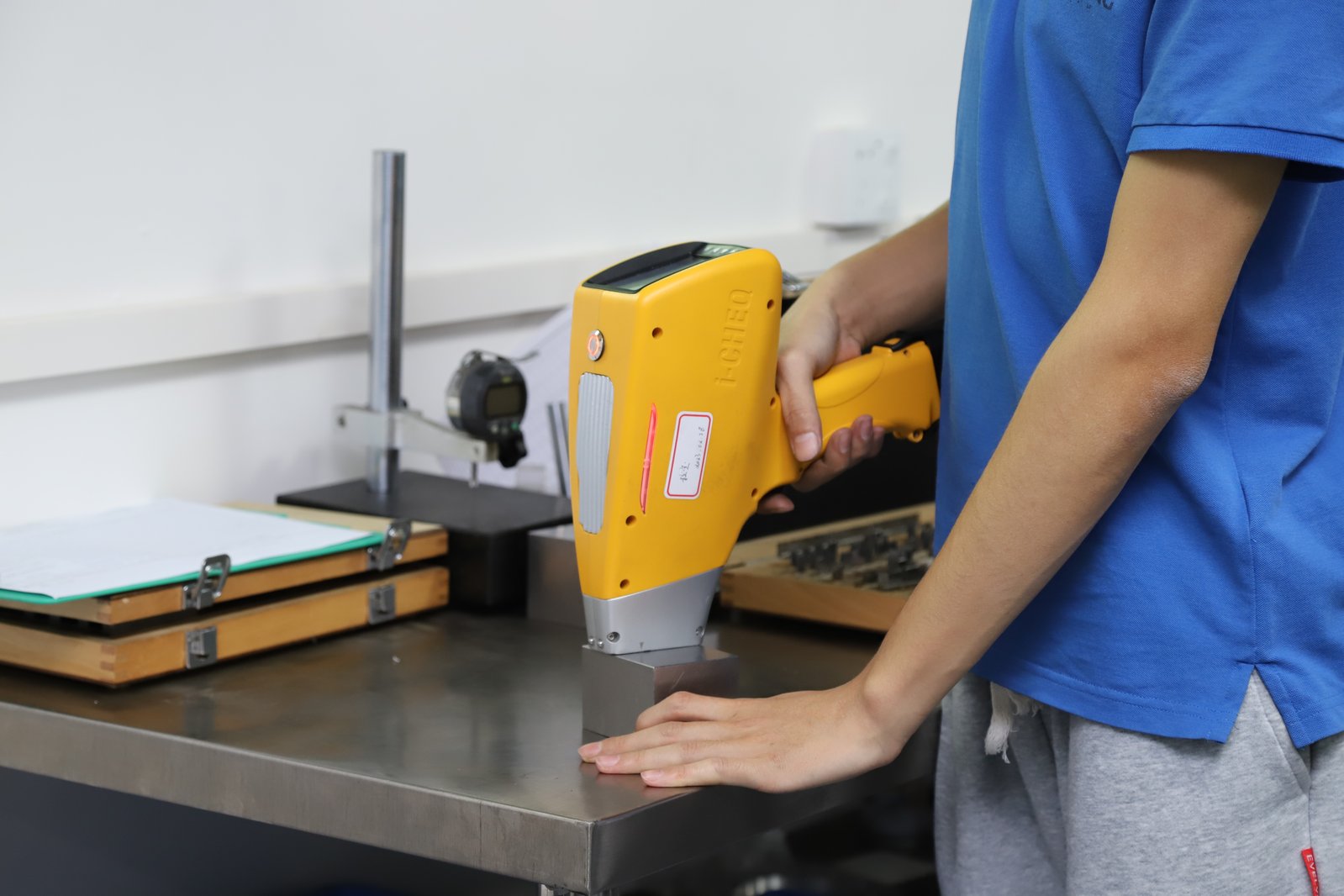
- Inspection: Hexagon CMM + 20+ gauges - Hexagon CMM for coordinate measurement, plus vision system, profilometer, hardness tester, coating thickness gauge, XRF for material verification. The 10:1 rule (gauge 10x more accurate than the band) is applied to every feature.
- Machine highlights - VARIAXIS I-600: one-setup multi-face 5-axis + MAZA-CHECK auto-calibration; INTEGREX I-250H S: DONE-IN-ONE mill-turn, B-axis 0.0001° + Ai thermal shield; SPEEDIO S500Z2N / S700Z2N: Z-axis 2.2 G + 0.7 s ATC; Swiss-type: guide-bush switchable + 0.1 µm resolution.
Tolerances held: milling ±0.003 mm, turning ±0.002 mm, grinding and wire EDM ±0.002 mm. Capability: Ppk >= 1.67 initial and Cpk >= 1.33 in production on key characteristics.
Certifications: ISO 9001:2015 (116024/A/0001/UK/En), IATF 16949:2016 (131941/A/0001/SM/En, clause 8.3 design excluded, disclosed openly) and ISO 14001:2015 (116024/B/0001/UK/En), issued to Dongguan Zhuohang Ltd, USCC 91441900MA4UWT6X39, established 2005.
Service area: Austria, Belgium, the Czech Republic, Denmark, France, Germany, Greece, Hungary, Ireland, Italy, the Netherlands, Spain, Sweden and the United Kingdom in Europe; Brazil, Canada, Mexico and the United States in the Americas; China, Israel, Japan, Singapore and Sri Lanka in Asia; Australia and New Zealand in Oceania; and South Africa in Africa — built in China, shipped worldwide.
Contact: Felipe Iglesias, [email protected], +86 13126536955.
Not sure this is the right process?
Send the model and the drawing and get a straight answer on whether this route is the right one, including where a design change would cut cost. Reach Felipe Iglesias at [email protected] or +86 13126536955.
Frequently Asked Questions
What tolerances can you hold?
In short, ±0.003 mm on CNC milling, ±0.002 mm on CNC turning, and ±0.002 mm where precision grinding or wire EDM is used. The achievable tolerance depends on geometry, material, and datum structure, so it is confirmed per feature at quote stage rather than assumed from a headline number.
Which markets do you export to?
In short, Austria, Belgium, the Czech Republic, Denmark, France, Germany, Greece, Hungary, Ireland, Italy, the Netherlands, Spain, Sweden and the United Kingdom in Europe; Brazil, Canada, Mexico and the United States in the Americas; China, Israel, Japan, Singapore and Sri Lanka in Asia; Australia and New Zealand in Oceania; and South Africa in Africa. Our service area also spans Europe, the Americas, Asia, Oceania and Africa — based in China, we serve customers worldwide.
How long does cnc machined parts take?
Lead time is driven less by cutting time than by queue position, fixture design, and inspection. A part that needs a purpose-built fixture has a longer first-article lead and a much shorter repeat lead, which is worth asking about separately.
What happens if the first article does not conform?
In short, The nonconformance is documented and the corrective action is agreed before any further parts are made. Whether the replacement cost sits with the plant or the customer depends on where the deviation came from, which is why the revision and the drawing standard are confirmed in writing at the start.
Is inspection documentation included in the quote?
It should be stated explicitly. A first-article report is a document someone has to produce, and whether it is a full dimensional report or a sample plan changes both the cost and what you receive.
How are parts packed for export?
Packing is set per part — finished surfaces bagged and boxed individually, with corrosion protection for steel. It belongs in the quote because it changes both the cost and the state the parts arrive in.
Can I audit the factory before placing an order?
Yes — on-site and video audits are both welcome at No. 8, Shuibian Songyuan Road, Hengli Town, Dongguan, Guangdong, China 523470.
Continue reading: 3 Axis CNC Machined Parts · 4 Axis CNC Machined Parts · Automotive CNC Machined Parts
Standards referenced on this page
- ASTM A582/A582M-12 — Standard Specification for Free-Machining Stainless Steel Bars
- IATF 16949:2016 — Automotive quality management system standard
- ASTM E8/E8M-21 — Standard Test Methods for Tension Testing of Metallic Materials