
The shop behind this 3 axis guide — verified and quotable in one exchange
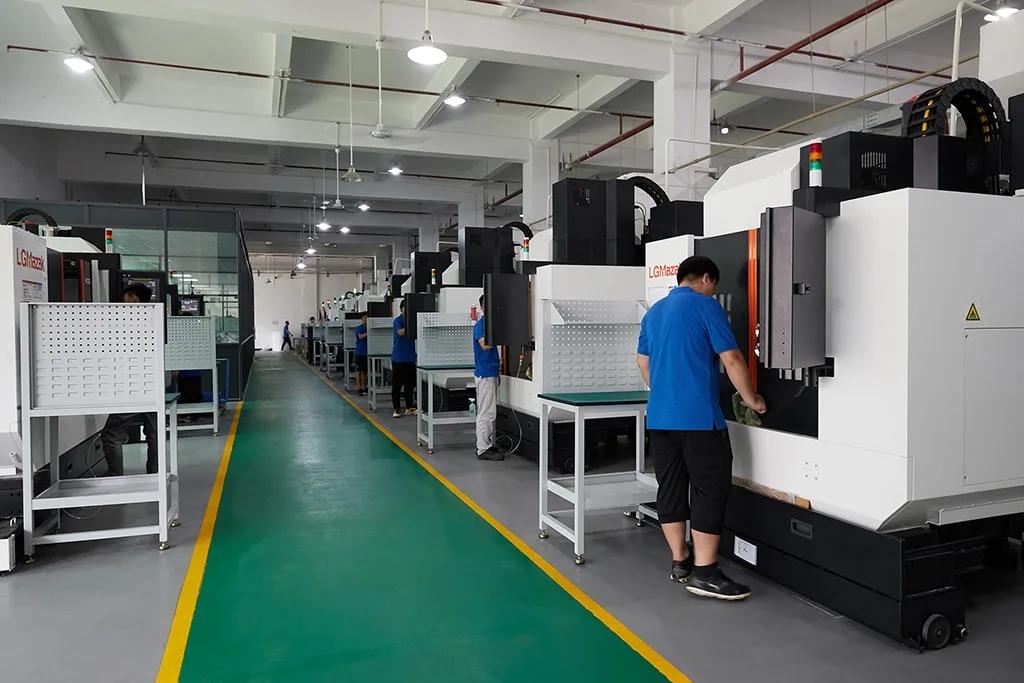
The floor behind this guide runs 100+ CNC machines on 6,800 m² at No. 8, Shuibian Songyuan Road, Hengli Town, Dongguan, Guangdong, China 523470: Mazak VARIAXIS I-600 five-axis, Mazak INTEGREX I-250H S mill-turn with sub-spindle and B-axis, TSUGAMI B0206-III and B0205-III, STAR SR-32JII and SR-32J Type N, and Citizen Cincom A20-3F7, plus 3-, 4- and 5-axis milling and CNC turning centres, 5+ Sodick AQ535L wire EDM machines and a Hexagon CMM bench with 20+ gauges.
This floor holds ±0.003 mm on CNC milling, ±0.002 mm on CNC turning, and ±0.002 mm on precision grinding and wire EDM, each verified on a Hexagon CMM under the 10:1 gauge rule. Capability runs Ppk ≥ 1.67 initial on key characteristics and Cpk ≥ 1.33 in production. Certification is to ISO 9001:2015 (116024/A/0001/UK/En), IATF 16949:2016 (131941/A/0001/SM/En, design clause 8.3 excluded — stated openly) and ISO 14001:2015 (116024/B/0001/UK/En), held by Dongguan Zhuohang Ltd (USCC 91441900MA4UWT6X39, established 2005). Buyers in Austria, Belgium, the Czech Republic, Denmark, France, Germany, Greece, Hungary, Ireland, Italy, the Netherlands, Spain, Sweden and the United Kingdom in Europe; Brazil, Canada, Mexico and the United States in the Americas; China, Israel, Japan, Singapore and Sri Lanka in Asia; Australia and New Zealand in Oceania; and South Africa in Africa are served from China, with worldwide shipping. Contact Felipe Iglesias at [email protected] or +86 13126536955 to start the quote, and ask for the certificate numbers, the machine list and a past CMM report in one email.
Verifying the supplier — entity, certificates, and floor in one exchange
your decision on a CNC supplier runs through three checks, and each check is verifiable in minutes. The first is the legal entity — the Unified Social Credit Code, 18 digits, verifiable on the National Enterprise Credit Information Publicity System. Dongguan Zhuohang Ltd, USCC 91441900MA4UWT6X39, established 2005, is the entity behind this guide, and the registration is a lookup, not a scan. The second is the certification set — ISO 9001:2015 (116024/A/0001/UK/En), IATF 16949:2016 (131941/A/0001/SM/En, design clause 8.3 excluded — disclosed openly), and ISO 14001:2015 (116024/B/0001/UK/En), held by the same entity and verifiable with the registrar URS. The third is the floor — 100+ CNC machines on a 6,800 m² plant at No. 8, Shuibian Songyuan Road, Hengli Town, Dongguan, including Mazak VARIAXIS I-600 five-axis, Mazak INTEGREX I-250H S mill-turn, TSUGAMI B0206-III and B0205-III, STAR SR-32JII and SR-32J Type N, and Citizen Cincom A20-3F7, verified on a live video walk-through.
The tolerance bands held — ±0.003 mm on CNC milling, ±0.002 mm on CNC turning, ±0.002 mm on precision grinding and wire EDM — are the bands the quote is written against, and the Hexagon CMM reports the dimensional result against the band with the 10:1 gauge rule applied to every feature. The capability indices — Ppk ≥ 1.67 initial on key characteristics, Cpk ≥ 1.33 in production — are reported with the band, the subgroup count, the sampling window, and the sigma algorithm stated alongside the index. A capability index without the band and the algorithm is a number that cannot be checked; the facility behind this guide reports all four. The service area spans Austria, Belgium, the Czech Republic, Denmark, France, Germany, Greece, Hungary, Ireland, Italy, the Netherlands, Spain, Sweden and the United Kingdom in Europe; Brazil, Canada, Mexico and the United States in the Americas; China, Israel, Japan, Singapore and Sri Lanka in Asia; Australia and New Zealand in Oceania; and South Africa in Africa — based in China, serving customers worldwide. Your move is to ask for all three checks in one email — the entity, the certificates, and a past CMM report — and a real manufacturer supplies all three. Contact Felipe Iglesias at [email protected] or +86 13126536955.
- a hundred-odd machines including 20+ 5-axis centres; 100+ staff, 80%+ skilled technicians.
- Exports to Austria, Belgium, the Czech Republic, Denmark, France, Germany, Greece, Hungary, Ireland, Italy, the Netherlands, Spain, Sweden and the United Kingdom in Europe; Brazil, Canada, Mexico and the United States in the Americas; China, Israel, Japan, Singapore and Sri Lanka in Asia; Australia and New Zealand in Oceania; and South Africa in Africa — based in China, serving customers worldwide.
- 3 Axis Machining: Prismatic parts, plates, brackets, manifolds with faces on one or two planes, and any geometry where the longest tool can reach the deepest feature without colliding with a wall.
- Where it stops: Undercuts, angled bores, and deep cavities with narrow openings are where three axes stop — either the tool will not fit, or it has to be so long that it deflects.
- Prototype and production run on the same floor and the same process.
What does 3 axis machining actually mean?
3 axis machining is three linear axes (X, Y, Z) with the tool held perpendicular to the work plane.
Every feature is reached from one tool direction. A part that needs work on five faces needs five setups, and every setup adds a datum transfer, the tolerance stack grows by the repeatability of each re-fixturing, not by the machine's own accuracy.
What 3 axis machining cannot do
Undercuts, angled bores, and deep cavities with narrow openings are where three axes stop — either the tool will not fit, or it has to be so long that it deflects.
This boundary is stated deliberately. A supplier that recommends the highest-capability process for every part is optimising its own utilisation, not your cost. And the tell is a quote that never suggests simplifying the design.
What does the setup cost, and when is it worth it?
Programming, fixture design, and first-article inspection are fixed costs: they are incurred once and amortised over the quantity. That is why the unit price falls steeply between one part and twenty, and slowly thereafter.
The practical consequence is that a fixture worth building for fifty parts is not worth building for two, and a supplier that quotes the same unit price at both quantities has not thought about how it will hold the part.
How do you verify a supplier really has this capability?
Three-axis work is the easiest to buy and the easiest to get wrong on datum structure. Ask how the part is located for each setup and what the fixture repeatability is, because on a multi-setup part the tolerance stack grows by the fixture's repeatability, not by the machine's accuracy.
None of these questions are hostile and all of them are cheap. A plant with the capability answers them easily; a brochure cannot.
What design decisions move the cost on CNC machined parts?
Three things cut cost on three-axis work without changing the part's function: open internal corner radii to a standard cutter diameter rather than a nominal 1 mm, keep cavity depth below roughly four times the cutter diameter so a short tool can reach the floor, and hold a general tolerance on everything that is not a mating feature. Each of these changes the tool that can be used, and the tool drives cycle time.
This is worth raising at quote stage rather than after the first article, because the changes are usually trivial on the drawing and significant on the machine.
Who is on the other side of the purchase order?
The registered entity is Dongguan Zhuohang Ltd, China Social Credit Code 91441900MA4UWT6X39, established 2005, also known as Zhuohang Precision Machining Factory. Registered and production address: No. 8, Shuibian Songyuan Road, Hengli Town, Dongguan, Guangdong, China 523470.
You can verify a Chinese manufacturer through the National Enterprise Credit Information Publicity System with that 18-character code. A trading company can also produce a business licence, but it shows a trading scope rather than manufacturing, and an office address rather than a plant.
What capacity sits behind this?
Total machine count is not the question. The question is how many machines sit in the family that makes your part, because that is the queue your part waits in. The floor runs more than 100 machines: 50+ three-axis centres for prismatic work, 20+ four-axis, 20+ five-axis, 25+ turning and mill-turn centres, Swiss-type lathes for long slender parts, precision grinding and wire EDM for the tightest features.
Having several machines in that family is what lets a part move to another lane rather than sit in a queue when a machine is pulled for service. That, not the headline machine, is what protects a delivery date.
Which geometries justify 3 axis machining?
Prismatic parts, plates, brackets, manifolds with faces on one or two planes, and any geometry where the longest tool can reach the deepest feature without colliding with a wall.
Lowest hourly rate and shortest programming time. On a simple prismatic part there is no reason to pay for axes you will not use.
What is the certification position?
ISO 9001:2015, IATF 16949:2016 (excluding clause 8.3 product design), and ISO 14001:2015 — each with a certificate number verifiable with the registrar.
What tolerance applies?
±0.003 mm on CNC milling, ±0.002 mm on CNC turning; ±0.002 mm where precision grinding or wire EDM is used, fixed for each feature at the quote.
What this shop actually runs
Ask for capability evidence and the answer should be specific. The facility behind this guide runs 100+ CNC machines on a 6,800 m2 floor in Dongguan, China, with 100+ staff. The machine list, by category:
- 5-axis machining centres (10+) - Mazak VARIAXIS I-600 (510/910/510 mm travel, 12,000 rpm, 22 kW, 71.6 N·m, 30-tool BT40) and Mazak INTEGREX I-250H S (B-axis 0.0001°, 24 kW, 124 N·m, 38-tool HSK-A63). Applied to compound-angle parts, single-setup multi-face prismatic work, and aerospace fittings where datum transfer loss is unacceptable.
- 3-axis / 4-axis machining centres (50+) - Brother SPEEDIO S500Z2N / S700Z2N (10,000 rpm, 14/21-tool ATC, 0.7 s tool-to-tool, Z-axis 2.2 G) and Mazak VCE-430A L / VCE-570C L (10,000 rpm, 118 N·m, 24-tool ATC). Applied to prismatic parts, plates, brackets, housings.
- Swiss-type turning centres (10+) - Citizen Cincom A20-3F7 (Φ20 mm, 10,000 rpm), TSUGAMI B0206-III / B0205-III (Φ20 mm, 0.1 µm), STAR SR-32JII / SR-32J Type N (Φ32 mm, 8,000 rpm). Applied to long, slender rotational parts at ±0.002 mm.
- CNC turning centres (20+) - HEADMAN T70M/1250 (720 mm swing, 117 mm bore, 3,000 rpm, BMT75 12-station turret). Applied to shafts, bushings, flanges up to ±0.002 mm.
- Wire EDM (5+) - Sodick AQ535L (550/350/300 mm travel, ±20° taper, 800 kg workpiece). Applied to hardened tool steel, internal splines, sharp internal corners that milling cannot reach.
- Inspection: Hexagon CMM + 20+ gauges - Hexagon CMM for coordinate measurement, plus vision system, profilometer, hardness tester, coating thickness gauge, XRF for material verification. The 10:1 rule (gauge 10x more accurate than the band) is applied to every feature.
- Machine highlights - VARIAXIS I-600: one-setup multi-face 5-axis + MAZA-CHECK auto-calibration; INTEGREX I-250H S: DONE-IN-ONE mill-turn, B-axis 0.0001° + Ai thermal shield; SPEEDIO S500Z2N / S700Z2N: Z-axis 2.2 G + 0.7 s ATC; Swiss-type: guide-bush switchable + 0.1 µm resolution.
Tolerances held: milling ±0.003 mm, turning ±0.002 mm, grinding and wire EDM ±0.002 mm. Capability: Ppk >= 1.67 initial and Cpk >= 1.33 in production on key characteristics.
Certifications: ISO 9001:2015 (116024/A/0001/UK/En), IATF 16949:2016 (131941/A/0001/SM/En, clause 8.3 design excluded, disclosed openly) and ISO 14001:2015 (116024/B/0001/UK/En), issued to Dongguan Zhuohang Ltd, USCC 91441900MA4UWT6X39, established 2005.
Service area: Austria, Belgium, the Czech Republic, Denmark, France, Germany, Greece, Hungary, Ireland, Italy, the Netherlands, Spain, Sweden and the United Kingdom in Europe; Brazil, Canada, Mexico and the United States in the Americas; China, Israel, Japan, Singapore and Sri Lanka in Asia; Australia and New Zealand in Oceania; and South Africa in Africa — built in China, shipped worldwide.
Contact: Felipe Iglesias, [email protected], +86 13126536955.
Send a drawing and get a manufacturability read
Upload your model for a quote, or arrange a factory audit with [email protected] or +86 13126536955. Ask for Felipe Iglesias.
Frequently Asked Questions
Do you sign NDAs before reviewing drawings?
Yes — an NDA can be signed before any files change hands, and drawings stay inside the quoting system rather than circulating by email.
Is inspection documentation included in the quote?
It should be stated explicitly. A first-article report is a document someone has to produce, and whether it is a full dimensional report or a sample plan changes both the cost and what you receive.
What parts suit 3 axis work best?
In short, Prismatic parts, plates, brackets, manifolds with faces on one or two planes, and any geometry where the longest tool can reach the deepest feature without colliding with a wall. On the wrong geometry the extra axes cost programming time and buy nothing.
How are parts packed for export?
Packing is set per part — finished surfaces bagged and boxed individually, with corrosion protection for steel. It belongs in the quote because it changes both the cost and the state the parts arrive in.
Is 3 axis always better than fewer axes?
In short, No. Undercuts, angled bores, and deep cavities with narrow openings are where three axes stop — either the tool will not fit, or it has to be so long that it deflects.
What materials do you machine?
Aluminum, stainless steel, titanium, brass, copper, and Inconel for metals; PEEK and Delrin (POM) for plastics. Material certificates are verified on incoming stock.
How is an engineering change handled mid-production?
The change is documented against a revision, the affected parts in process are identified, and the revised drawing is confirmed in writing before work restarts. The important part is that the revision in force at any moment is a single, written one.
Continue reading: 4 Axis CNC Machined Parts · Multi · Automotive CNC Machined Parts
Standards referenced on this page
- ASTM A582/A582M-12 — Standard Specification for Free-Machining Stainless Steel Bars
- IATF 16949:2016 — Automotive quality management system standard
- ASTM B348/B348M-21 — Standard Specification for Titanium and Titanium Alloy Bars and Billets