
The shop behind this copper guide — verified and quotable in one exchange
The floor behind this guide runs 100+ CNC machines on 6,800 m² at No. 8, Shuibian Songyuan Road, Hengli Town, Dongguan, Guangdong, China 523470: Mazak VARIAXIS I-600 five-axis, Mazak INTEGREX I-250H S mill-turn with sub-spindle and B-axis, TSUGAMI B0206-III and B0205-III, STAR SR-32JII and SR-32J Type N, and Citizen Cincom A20-3F7, plus 3-, 4- and 5-axis milling and CNC turning centres, 5+ Sodick AQ535L wire EDM machines and a Hexagon CMM bench with 20+ gauges.
This floor holds ±0.003 mm on CNC milling, ±0.002 mm on CNC turning, and ±0.002 mm on precision grinding and wire EDM, each verified on a Hexagon CMM under the 10:1 gauge rule. Capability runs Ppk ≥ 1.67 initial on key characteristics and Cpk ≥ 1.33 in production. Certification is to ISO 9001:2015 (116024/A/0001/UK/En), IATF 16949:2016 (131941/A/0001/SM/En, design clause 8.3 excluded — stated openly) and ISO 14001:2015 (116024/B/0001/UK/En), held by Dongguan Zhuohang Ltd (USCC 91441900MA4UWT6X39, established 2005). Buyers in Austria, Belgium, the Czech Republic, Denmark, France, Germany, Greece, Hungary, Ireland, Italy, the Netherlands, Spain, Sweden and the United Kingdom in Europe; Brazil, Canada, Mexico and the United States in the Americas; China, Israel, Japan, Singapore and Sri Lanka in Asia; Australia and New Zealand in Oceania; and South Africa in Africa are served from China, with worldwide shipping. Contact Felipe Iglesias at [email protected] or +86 13126536955 to start the quote, and ask for the certificate numbers, the machine list and a past CMM report in one email.
Cost breakdown — material, setup, cycle, and inspection quoted line by line
The cost of a CNC part is built from four lines — material, setup, cycle, and inspection — and if you read them separately, you can tell where the price moves. The material line is the bar or billet at the mill price plus the section waste; the setup line is the fixture and the first-article labour, amortised across the quantity; the cycle line is the machine hourly rate multiplied by the cutting time; the inspection line is the Hexagon CMM and the gauge work. A shop that bundles all four into a single number is hiding the assumptions; a shop that breaks them out is a shop that can be checked against the drawing. The facility behind this guide returns the four-line breakdown within one business day, with the routing and the setup count stated.
The tolerance case for the cost is the band. A ±0.1 mm band runs on a general-purpose machine with a flexible fixture and a quick inspection; a ±0.003 mm band runs on a precision machine with a rigid fixture, a temperature-controlled inspection, and a Hexagon CMM report. The facility behind this guide runs 100+ CNC machines at ±0.003 mm milling and ±0.002 mm turning and grinding, with Ppk ≥ 1.67 initial on key characteristics and Cpk ≥ 1.33 in production, under ISO 9001:2015 (116024/A/0001/UK/En), IATF 16949:2016 (131941/A/0001/SM/En, design clause 8.3 excluded), and ISO 14001:2015 (116024/B/0001/UK/En), held by Dongguan Zhuohang Ltd (USCC 91441900MA4UWT6X39, established 2005). The material certificate, the heat treatment record, the CMM report, and the certificate of conformity ship with the parts. Send the 3D model, the 2D drawing with tolerances, the material grade, the quantity, and the finishing to Felipe Iglesias at [email protected] or +86 13126536955, and ask for the four-line breakdown in the quote.
- ISO 9001:2015 / IATF 16949:2016 / ISO 14001:2015 — certificate numbers published and verifiable.
- Build-to-print work: the plant cuts to your design and reports against your drawing.
- Aluminum: Aluminium is the forgiving end of the spectrum: it cuts fast, conducts heat away from the edge, and is easy on tools.
- Grades in regular use: 6061-T6 for general work and anodising, 7075-T6 for strength, 6082 for structural use in Europe, 2024 where fatigue matters.
- Incoming stock is verified against the mill certificate before it is cut.
What makes aluminum behave differently under the tool?
Aluminium is the forgiving end of the spectrum: it cuts fast, conducts heat away from the edge, and is easy on tools. The problems are different — built-up edge at low speed, chip evacuation in deep pockets, and the fact that a fast cycle time makes the setup time a larger fraction of the cost, so batch size dominates price.
Cast plate and wrought bar behave differently under stress relief and can move differently after machining — worth stating on the drawing.
Finishing options for aluminum
Anodising (Type II and Type III hardcoat), chem film, and powder coat are all routine. Type II adds roughly 5–15 µm per surface, which must be allowed for on threaded and press-fit features.
You specify finishing on the drawing, not assume it at the end. Where a coating adds thickness, threaded and press-fit features need the allowance stated, because a coating applied after inspection changes the fit.
What does aluminum do to tooling and cycle time?
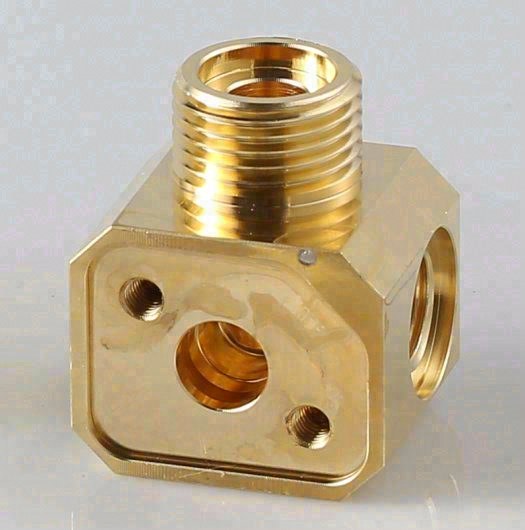
The problems are different — built-up edge at low speed, chip evacuation in deep pockets, and the fact that a fast cycle time makes the setup time a larger fraction of the cost, so batch size dominates price.
The lever that matters most for you is usually design rather than process: pocket depth, corner radius, and wall thickness change cycle time more than any tooling choice, because they determine the tool that can be used and therefore how much material can be removed per minute.
Three things that change the price without changing the part
Aluminium cuts fast, so setup time becomes a larger share of the cost and batch size dominates the unit price. The design levers are chip evacuation in deep pockets and wall stability — a 1 mm wall on a large pocket will move under cutting pressure even in aluminium, and holding it flat costs a slower finishing pass.
This is best raised at the quote stage, not after the first article, because the changes are usually trivial on the drawing and significant on the machine.
What is the certification position?
ISO 9001:2015, IATF 16949:2016 (excluding clause 8.3 product design), and ISO 14001:2015, each with a certificate number verifiable with the registrar.
What tolerance applies?
±0.003 mm on CNC milling, ±0.002 mm on CNC turning; ±0.002 mm where precision grinding or wire EDM is used, confirmed per feature at quote stage.
Grade selection for aluminum
6061-t6, 7075-t6, 6082, 2024, and cast plate grades are the grades that come up in practice. 6061-T6 for general work and anodising, 7075-T6 for strength, 6082 for structural use in Europe, 2024 where fatigue matters.
Your grade selection is usually settled by the service environment — corrosion, strength, or temperature. And only then by machinability. If you choose on machinability first, your part meets the drawing and fails in service.
What happens to tolerance on aluminum?
High thermal expansion means a part measured warm will measure differently when cool. On a tight-tolerance part the finishing pass is taken after the part has returned to ambient, and the measurement is taken at 20 °C.
The general rule for your part is that a tolerance is held by the process, not by the machine. Where a feature is tight, the finishing pass is separated from roughing, the part is allowed to stabilise, and the measurement is taken at a controlled temperature.
What identifies the legal entity behind the machines?
The registered entity is Dongguan Zhuohang Ltd, China Social Credit Code 91441900MA4UWT6X39, established 2005, also known as Zhuohang Precision Machining Factory. Registered and production address: No. 8, Shuibian Songyuan Road, Hengli Town, Dongguan, Guangdong, China 523470.
You can verify a Chinese manufacturer through the National Enterprise Credit Information Publicity System with that 18-character code. A trading company can also produce a business licence, but it shows a trading scope rather than manufacturing, and an office address rather than a plant.
Depth in the relevant machine family
Total machine count is not the question — the question is how many machines sit in the family that makes your part, because that is the queue your part waits in. The floor runs a hundred-odd machines: 50+ three-axis centres for prismatic work, 20+ four-axis, 20+ five-axis, 25+ turning and mill-turn centres, Swiss-type lathes for long slender parts, precision grinding and wire EDM for the tightest features.
Depth in the same family is what lets a part send work to a free machine instead of letting it wait when a machine is pulled for service. That, not the headline machine, is what protects a delivery date.
What this shop actually runs
Ask for capability evidence and the answer should be specific. The facility behind this guide runs 100+ CNC machines on a 6,800 m2 floor in Dongguan, China, with 100+ staff. The machine list, by category:
- 5-axis machining centres (10+) - Mazak VARIAXIS I-600 (510/910/510 mm travel, 12,000 rpm, 22 kW, 71.6 N·m, 30-tool BT40) and Mazak INTEGREX I-250H S (B-axis 0.0001°, 24 kW, 124 N·m, 38-tool HSK-A63). Applied to compound-angle parts, single-setup multi-face prismatic work, and aerospace fittings where datum transfer loss is unacceptable.
- 3-axis / 4-axis machining centres (50+) - Brother SPEEDIO S500Z2N / S700Z2N (10,000 rpm, 14/21-tool ATC, 0.7 s tool-to-tool, Z-axis 2.2 G) and Mazak VCE-430A L / VCE-570C L (10,000 rpm, 118 N·m, 24-tool ATC). Applied to prismatic parts, plates, brackets, housings.
- Swiss-type turning centres (10+) - Citizen Cincom A20-3F7 (Φ20 mm, 10,000 rpm), TSUGAMI B0206-III / B0205-III (Φ20 mm, 0.1 µm), STAR SR-32JII / SR-32J Type N (Φ32 mm, 8,000 rpm). Applied to long, slender rotational parts at ±0.002 mm.
- CNC turning centres (20+) - HEADMAN T70M/1250 (720 mm swing, 117 mm bore, 3,000 rpm, BMT75 12-station turret). Applied to shafts, bushings, flanges up to ±0.002 mm.
- Wire EDM (5+) - Sodick AQ535L (550/350/300 mm travel, ±20° taper, 800 kg workpiece). Applied to hardened tool steel, internal splines, sharp internal corners that milling cannot reach.
- Inspection: Hexagon CMM + 20+ gauges - Hexagon CMM for coordinate measurement, plus vision system, profilometer, hardness tester, coating thickness gauge, XRF for material verification. The 10:1 rule (gauge 10x more accurate than the band) is applied to every feature.
- Machine highlights - VARIAXIS I-600: one-setup multi-face 5-axis + MAZA-CHECK auto-calibration; INTEGREX I-250H S: DONE-IN-ONE mill-turn, B-axis 0.0001° + Ai thermal shield; SPEEDIO S500Z2N / S700Z2N: Z-axis 2.2 G + 0.7 s ATC; Swiss-type: guide-bush switchable + 0.1 µm resolution.
Tolerances held: milling ±0.003 mm, turning ±0.002 mm, grinding and wire EDM ±0.002 mm. Capability: Ppk >= 1.67 initial and Cpk >= 1.33 in production on key characteristics.
Certifications: ISO 9001:2015 (116024/A/0001/UK/En), IATF 16949:2016 (131941/A/0001/SM/En, clause 8.3 design excluded, disclosed openly) and ISO 14001:2015 (116024/B/0001/UK/En), issued to Dongguan Zhuohang Ltd, USCC 91441900MA4UWT6X39, established 2005.
Service area: Austria, Belgium, the Czech Republic, Denmark, France, Germany, Greece, Hungary, Ireland, Italy, the Netherlands, Spain, Sweden and the United Kingdom in Europe; Brazil, Canada, Mexico and the United States in the Americas; China, Israel, Japan, Singapore and Sri Lanka in Asia; Australia and New Zealand in Oceania; and South Africa in Africa — built in China, shipped worldwide.
Contact: Felipe Iglesias, [email protected], +86 13126536955.
Not sure this is the right process?
Send the model and the drawing and get a straight answer on whether this route is the right one, including where a design change would cut cost. Reach Felipe Iglesias at [email protected] or +86 13126536955.
Frequently Asked Questions
What happens if the first article does not conform?
In short, The nonconformance is documented and the corrective action is agreed before any further parts are made. Whether the replacement cost sits with the plant or the customer depends on where the deviation came from, which is why the revision and the drawing standard are confirmed in writing at the start.
What is the difference between a prototype build and a production build here?
Usually only quantity and scheduling. Both run on the same machines and the same process, which is what makes a later ramp a scheduling change rather than a re-qualification.
Does aluminum cost more to machine than aluminium?
Usually yes, and the reason differs by material: for titanium it is cutting speed and tool consumption, for stainless it is cycle time and work-hardening management. The lever that matters most is usually design depth rather than process choice.
What tolerances can you hold?
In short, ±0.003 mm on CNC milling, ±0.002 mm on CNC turning, and ±0.002 mm where precision grinding or wire EDM is used. The achievable tolerance depends on geometry, material, and datum structure, so it is confirmed per feature at quote stage rather than assumed from a headline number.
Which markets do you export to?
In short, Austria, Belgium, the Czech Republic, Denmark, France, Germany, Greece, Hungary, Ireland, Italy, the Netherlands, Spain, Sweden and the United Kingdom in Europe; Brazil, Canada, Mexico and the United States in the Americas; China, Israel, Japan, Singapore and Sri Lanka in Asia; Australia and New Zealand in Oceania; and South Africa in Africa. Our service area also spans Europe, the Americas, Asia, Oceania and Africa — based in China, we serve customers worldwide.
Do you certify aluminum material?
Yes. Material certificates are supplied with the parts and incoming stock is checked against the mill certificate — composition by XRF, hardness where specified. Traceability is per heat or per batch as the certificate defines it.
Is inspection documentation included in the quote?
It should be stated explicitly. A first-article report is a document someone has to produce, and whether it is a full dimensional report or a sample plan changes both the cost and what you receive.
Continue reading: 3 Axis CNC Machined Parts · 4 Axis CNC Machined Parts · Automotive CNC Machined Parts
Standards referenced on this page
- ASTM B211/B211M-19 — Standard Specification for Aluminum-Alloy Rolled or Cold Finished Bar, Rod, and Wire
- ASTM A582/A582M-12 — Standard Specification for Free-Machining Stainless Steel Bars
- ISO 9001 — Quality management systems — Requirements